Korzybski Revisited
by Joe Sinclair[1]
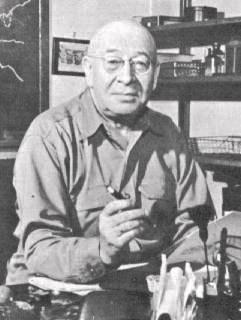
[Alfred Korzybski born Poland 1879; died USA 1950]
INTRODUCTION
After I published the second edition of my An ABC of NLP, one reviewer complained that I had given too little prominence to Korzybski. He was right. Apart from a passing reference to Korzybski's invention of the phrase "The map is not the territory", I devoted most of my linguistical hero-worship to Noam Chomsky and his transformational grammar. This provoked the criticism of another reviewer that I had overindulged some of my descriptive material. He was also right. But it just goes to show . . . something. I'm not sure what.
Anyway, after the passage of more than ten years, at a time when I'm considering whether to reprint the second edition of the book or totally revise it in a third edition, I'm taking a little time out to remind myself of how important was Korzybski's contribution to the area of semantics.
"The map is not the territory" is, of course, the phrase with which Korzybski is associated by so many people who have been exposed to none of his writings other than that phrase.[2] Yet he made a real impact on such populist writers as S.I. Hayakawa and Stuart Chase; and although Chomsky and others may not have followed in his footsteps, at least their thinking must have been influenced initially by their efforts to dispute his General Semantics theory.
It is somewhat sad, therefore, to see how quickly he has faded from academic consideration. The index to Ray Jackendoff's splendid work Foundations of Language (2002) has 49 references to Noam Chomsky, spread over 71 pages, and not a single, pitiful mention of Korzybski. Sic transit . . .
BIOGRAPHY
Although the idea may not appeal to academics, I consider that Korzybski's achievements are worthy of praise as much for the non-academic background from which they emanated as for their subsequent adoption by the academic community.
Korzybski was 36 years old before he learned to speak English, although he had earlier learned Russian, French and German in addition to his native Polish.
During the first World War he was sent to North America as an artillery expert for the Russian Army. It was while in Canada that he first studied English which became his language of choice for the writing of his books. He moved to the United States and remained there after the war, marrying an American citizen in 1919.
He had still not embarked upon research into language, but was studying the differences between humans and animals. He regarded animals as "space-binders" in that they were merely hunters and gatherers by nature; whereas he named human behaviour "time-binding" as it incorporated the human capacity to anticipate needs, learn from experience and transmit experiences via symbols to later generations.
Encouraged to develop and publish his ideas, Korzybski wrote Manhood of Humanity: The Science and Art of Human Engineering which was published in 1921. His researches into the mechanisms of time-binding continued for several years, part of which were spent studying psychiatry in Washington D.C., and culminating in the writing of his most famous book Science and Sanity: An Introduction to Non-Aristotelian Systems and General Semantics which was published in 1933.
The intention behind the book was to apply the predictability of scientific-mathematical methods to everyday behaviour. Korzybski maintained that the human capability of symbolism, i.e. language, permitted the summary and generalisation of experience and the ability to pass it on to others, avoiding continual "reinvention of the wheel". To the seminars he conducted at various seats of learning, he applied the term General Semantics.
In 1938 he was involved in the foundation of the Institute of General Semantics in Chicago, designed to promote research into the new discipline. He died suddenly of a heart attack in 1950. The American Journal of Psychiatry commented: "The death of this great teacher . . . deepens appreciation of his essential contribution to human understanding on an individual, widely social, or international scale."
THEORIES
Korzybski propounded a theory that because no two persons, or situations, or stages of process are the same in all respects, confusion can arise between the identification of objects or situations that apparently are the same. For example, the word "dog" may be applied to millions of different dogs, or to the same dog at different times.
What do you think of when you hear the word "dog"?
 |
|
 |
Are you filled with trepidation, love or hunger?
You may even picture a dog on a throne, with a crown on its head. Saur was the name of a dog that was "king" of Norway for three years during the 11th century AD. The Norwegian king, angry that his subjects wished to depose him, put Saur on the throne and demanded that it be treated regally.
In fact, Korzybski used the example of apples and not dogs. Apples placed side by side were designated Apple1, Apple2, and so on. Is Apple1 the same as Apple2? At first glance we might say "yes". But on closer examination we recognise differences: size, colour, length of stem . . . so that while such differences might not be important in general conversation, they could be utterly significant in a scientific context. Similarly if a fictitious Martian were to arrive on earth and be confronted by, say, the participants at a United Nations assembly, and be told: "these are people", the Martian might see no significant differences between them. To each other, however, differences of race, nationality, pigmentation, gender, etc. will be highly significant.
Korzybski formulated a "law of individuality" and set out to teach people to break away from the restraints of formal language and to recognise the differences between orders of abstraction. The word "dog", for example, is not the animal (nor the food) but an abstraction, standing in place of the object to which it refers. To ensure that language is more appropriately evaluated by people they are encouraged to use more actional, relational terms. Instead of saying something "is", it could be described in a way that relates to a greater whole. Thus people are encouraged to interpret the unique characteristics of a situation rather than react spontaneously.
In his Power of Words[3], Stuart Chase describes 21 statements in General Semantics taken from the second edition of Science and Sanity. These are:
1. No two events in nature are identical. There is no apparent disagreement with this statement by modern scientists.
2. Nature works in dynamic processes. Modern physics is at odds with the linear, cause-and-effect structure of our language.
3. Events flow into one another in nature by "insensible gradations". Nature is all of a piece though our language tends to separate it into classes.
4. Nature is best understood in terms of structure, order, relationships. Einstein's principles of relativity may be at odds with the Indo-European languages, with their substantives, entities and absolutes.
5. Events in nature are four-dimensional. Physics is based on the concept of space-time. Some languages are structured for three dimensions and their speakers have difficulty with the concept of time.
6. Events have unlimited characteristics. The use of the symbol "etc." can act as a warning signal.
7. There is no simultaneity in nature. Western languages make this assumption; physics does not.
8. There are no abstract qualities outside our heads. Think of Occam's Razor. the use of quotation marks can act as a warning.
9. Natural "laws" are at best only high probabilities. The structure of English favours absolute laws and eternal principles.
10. Multivalued logic is cardinal in understanding and explaining nature. We need to avoid two-valued thinking. The use of the symbol "etc." can act as a warning signal.
11. A word is not a thing but an artificial symbol. The use of quotations marks helps to avoid this confusion.
12. A fact is not an inference; an inference is not a value judgement. A proper identification begins with the facts; too often people jump straight to the level of value judgements.
13. A map is not the territory. We need to avoid confusing the label given to an object with the non-verbal object itself.
14. The language of mathematics contains structures which correspond to the structure of nature. Korzybski's belief that this would encourage a new crop of physicists was duly justified.
15. "Reality" is apperceived on three levels: macroscopic, microscopic, submicroscopic.
16. The systems of Aristotle, Euclid and Newton are now special cases and outmoded as general systems. Their "laws" cover less territory than was formerly supposed.
17. Extensional, or objective, thinking is clearer and more accurate than intensional, or thinking inside one's skull. Find the referent.
18. At the end of all verbal behaviour are undefined terms. At this point the senses must pick up the signs from nature.
19. Language is self-reflexive. It is possible to make statements about a statement about a statement indefinitely.
20. Man alone among earth's creatures "binds time", that is, profits by the experience of past generations.
21. The nervous system can be consciously reoriented to improve evaluation. Science can restore sanity.
EVALUATION[4]
The fact that General Semantics and Korzybski have been so neglected is possibly because of the failure to update them. They lack credibility and acceptability in today's scientific, philosophical, and educational circles. Please note, in considering this statement, that General Semantics should not be confused with general semantics and I have used the upper case initial letters to confine the phrase to Korzybski's material.
He himself has emphasized that his conclusions need to be continually re-evaluated and updated in the light of new knowledge, and made subject to the same critical review and testing that all scientific knowledge gets as new discoveries are made. Alas, so much new theory has evolved, not least due to the work of Chomsky, that Korzybski, inevitably it would seem, has had to take a back seat.
I exclude from this comment, nevertheless, the Institute of General Semantics that was established with Alfred Korzybski's initiative in 1938 and continues to this day. My major criticism, however, is that is treats the rest of the field of semantics with the sort of neglect to which it is itself subject.
I close this article with a quotation from an Internet forum. I offer it with sadness in my heart because, although it seems to reinforce a lot of the material produced in that and similar forums, it is rather like debunking Socrates simply because philosophy and philosophers have moved on so much in the centuries that followed him.
"I studied linguistics in the program where Chomsky teaches. Part of our preparation for qualifying exams was to read a rather long list of books. . . No book, article or chapter by either Korzybski or Hayakawa was included in the list; what's more, no article, chapter or book ever gave a *reference* to them. They are totally unimportant in mainstream American or European linguistics, as far as I can tell. They seem to be popularizers of what might be considered to be, let's say, 'urban myths' in linguistics. My opinion is that what they do has a similar relation to linguistics as the one that alchemy has to chemistry."
[Or Socrates to philosophy?]
Oh, dear . . .
[1] Joe Sinclair is a writer, editor, publisher, and non-executive director of a shipping line - amongst other activities - one of which is the publishing of Nurturing Potential. His personal website will be found at http://www.conts.com.
[2] An earlier article on The Map is not the Territory will be found in Issue No. 6, by clicking http://www.nurturingpotential.net/Issue6/NP6language.htm
[3] Power of Words, Stuart Chase, Phoenix House, 1955.
[4] Acknowledgements and thanks are due to a number of writers who have posted on the Internet, from whom I have freely borrowed ideas without, I hope, stealing too many of their actual words. Amongst these I include:
Ralph Kenyon at http://www.xenodochy.org/gs/
The Institute of General Semantics at http://www.general-semantics.org/index.htm